Saturday, June 4th.
After a carpool in Hailey, a drive down Hwy 93 through the lava fields and then the rolling hills of potato fields just starting up after a long Winter, we met at the Idaho Fish and Game headquarters in Jerome.
Giving the class lecture was Chuck Peterson, Professor of Biological Sciences at Idaho State University.
An interesting show on species distribution and characteristics in the Northwest of amphibians and reptiles. With amazing compilations of years of study and radio tracking made for a riviting learning experience.
With live specimens in hand, Chuck even allowed us to safely examine a rattlesnake closeup.
Sliding a tube over the head of the snake allowed it to be handled safely.
After a brownbag lunch, we headed down to a Fish and Game preserve down into the canyon of the Snake River, south of Wendel.
Spring runoff had the river roaring.
We headed out into the preserve, noting that we ourselves were being observed.
So off to the hunt , to see what denizens were active.
First specimen was a toad, checked for health and sex.
A bullfrog, who has a call sounding quite a bit like a bovine.
And a young gopher snake
After a bit of traipsing, we headed back to the vehicles, watched by a growing number of locals.
On the way out, we had to stop to remove an adamant gopher snake about 3 feet long from the road.
Adding a new link in the link section to the diverse Idaho Atlas web site.
Monday, June 6, 2011
Monday, April 11, 2011
Wetlands Ecology Class
Wetland Ecology
April 9th, 2011
Silver Creek Preserve
Picabo, Idaho
9:30 am, lots of cumulus and patchy sun.
Starting off in Hailey, Idaho, we journeyed to local Lyons park to see restoration projects along the wetlands of the Wood River.
While there, we saw an Osprey with a fresh trout for breakfast, a Blue Heron, beaver ponds, a Muskrat, Mallard ducks, and a Red Headed Woodpecker.
A good indicator of wetland health. An abundance of life a mile from town.
From there we traveled to Silver Creek Preserve, the world renowned trout fishing preserve.
But we were out for smaller game.
Although we saw Canadian Geese, more Mallards, some large troutsies, and a Northern Harrier.
The weather became cooler, with a few Spring showers threatening.
With our fearless leader, Ms York in the lead we set off to assay stream health.
(She was also the only person with the proper footwear to get in the stream.)
After collecting samples, and sorting the species , we classified the inhabitants by identifying them.
So with the help of Species flash cards, we learned the names and dispositions of our guests.
After classifying, we counted. And the number and type of the stream denizen living in a test area indicate how healthy the stream is, because species are pollution tolerant, semi-tolerant, or not tolerant.
So the lack or low count of non tolerant species indicate pollution.
Happy to say, Silver Creek Preserve and the Nature Conservancy are doing pretty well.
And one thing I can say, That I have never regretted taking a jacket and gloves along when I go out in Idaho. :C)
Thursday, March 24, 2011
Snow Days at the SNRA 2011
Spring Break in the Wood River Valley.
Spring break 2001.
The SNRA Headquarters North of Ketchum Idaho.
Saturday Morning, March 19th, 2011
6 degrees, storm moving in.
The USFS and volunteers held 2 Snow Discovery days during Spring break.
Arts and crafts, puppet shows,
animal track plaster casts
Outside was a snow shelter, or Quinzee, exhibits and nature exhibit.
Animal Identification, snow shoe hikes,
Snow was examined and tested, temperature and mass.
Then it was back inside for another puppet show.
And to retrieve their nature handicrafts .
Spring break 2001.
The SNRA Headquarters North of Ketchum Idaho.
Saturday Morning, March 19th, 2011
6 degrees, storm moving in.
The USFS and volunteers held 2 Snow Discovery days during Spring break.
Arts and crafts, puppet shows,
animal track plaster casts
Outside was a snow shelter, or Quinzee, exhibits and nature exhibit.
Animal Identification, snow shoe hikes,
Snow was examined and tested, temperature and mass.
Then it was back inside for another puppet show.
And to retrieve their nature handicrafts .
Tuesday, March 22, 2011
Winter Ecology Hike
Winter Ecology Hike
Galena Lodge, 27 miles North of Ketchum, Highway 75
March, 5th 2011 Light stratus, lots of sunshine, circa 30F
The two Rangers from the SNRA, Jim and Robin, gave the Master Naturalist class a look into the world of wolverines , tree disease, and local Winter animal behavior.
We then met at the Galena Lodge for a hike into the hills.
After donning snowshoes we headed out, Robin pointing out and identifying tracks, and Jim identifying trees and infestations common to the area.
Tuesday, February 15, 2011
Golden Eagle watch-plus 25 year old mystery solved
February, week 7.
Weather: Lots of sun these weeks, no precipitation. High pressure system bominating the Northwest, spinning the weather over usinto Northern Idaho and keeping it from approaching from the South.
Reports state that we only have 25% of our snowfall for February and be in drought conditions again this Summer.
Temperatures have been warmer than average, highs hitting high 30's and only in the middle teens at night.
Just South of my place, 30 feet from the road is a carcass of it looks like a young elk, or cow.
Passing by I have seen a Golden Eagle there twice. Both times unable to stop, I returned and staked it out but it looks like the brunt of the food is already scavenged, leaving the magpies to pick at it.
While at the library, I found a handy, well illustrated "compendium" on the "Idaho Mountain Wildflowers" by A. Scott Earle. In it I found a photo of a flower I had seen once 25 years ago and never able to correctly identify it.
It looked to me, as I described it to otheres, like a cow skull, a white bleached cow skull.
Well, surprise , surprise. The Dicentra uniflora, , is commonly known as the "Long-horn Steer's Head"
Or just Steer's Head". Click the picture to learn more about it.
On other notes, I have to study more on photographing tracks in the snow. Hard to do with the contrast and white field of snow.
It looks ok, but hard to identify from the picture. I'm making it's tracks from the Stoat, or weasel that I have seen around here before.
Well, nuff for today.
Weather: Lots of sun these weeks, no precipitation. High pressure system bominating the Northwest, spinning the weather over usinto Northern Idaho and keeping it from approaching from the South.
Reports state that we only have 25% of our snowfall for February and be in drought conditions again this Summer.
Temperatures have been warmer than average, highs hitting high 30's and only in the middle teens at night.
Just South of my place, 30 feet from the road is a carcass of it looks like a young elk, or cow.
Passing by I have seen a Golden Eagle there twice. Both times unable to stop, I returned and staked it out but it looks like the brunt of the food is already scavenged, leaving the magpies to pick at it.
While at the library, I found a handy, well illustrated "compendium" on the "Idaho Mountain Wildflowers" by A. Scott Earle. In it I found a photo of a flower I had seen once 25 years ago and never able to correctly identify it.
It looked to me, as I described it to otheres, like a cow skull, a white bleached cow skull.
Well, surprise , surprise. The Dicentra uniflora, , is commonly known as the "Long-horn Steer's Head"
Or just Steer's Head". Click the picture to learn more about it.
On other notes, I have to study more on photographing tracks in the snow. Hard to do with the contrast and white field of snow.
It looks ok, but hard to identify from the picture. I'm making it's tracks from the Stoat, or weasel that I have seen around here before.
Well, nuff for today.
Tuesday, February 1, 2011
Snow Science Day Master Naturalist Program Jan-15-2011
Snow Science day
January 15 2011
Location : SNRA Headquarters
8 miles North of Ketchum
Class Time: 9:30 to 15:30
First observations : @ 9:00
Temperature : 7 F
Sky : Light clouds, high cirrus
Abundant sun
Ground : Frozen and dry
Wind : Slight breeze down valley
Course content : Snow impact on community and
implications for water in the West
Snow versus rain
: Snow formation and types and
metamorphosis
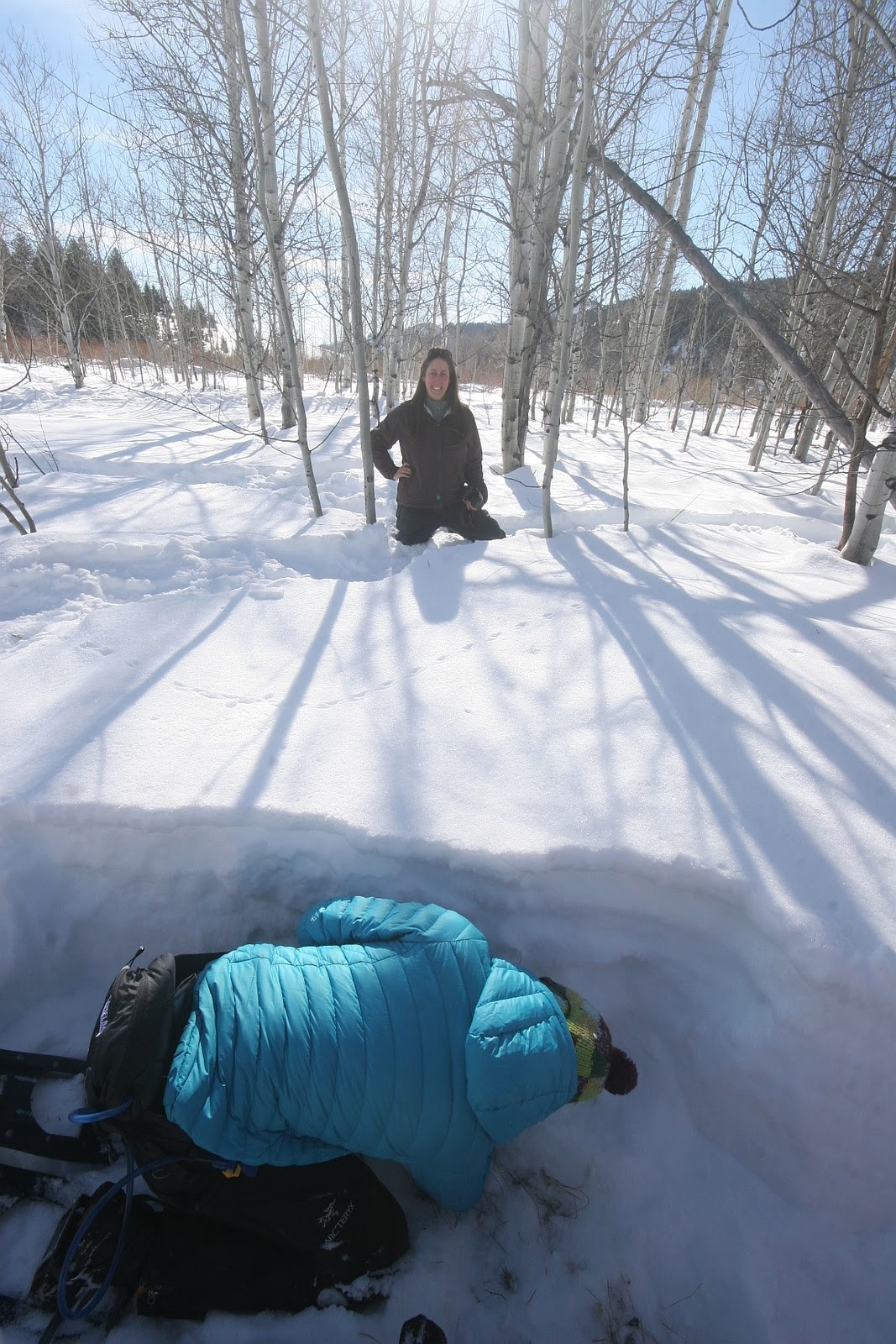
: Snow pit exploration and snow to
water ratio measurement.
Snow Exploration
Notes : New words - Albedo : % of light reflected
Sublimation : Transition from solid to gas without passing through a liquid stage.
January 15 2011
Location : SNRA Headquarters
8 miles North of Ketchum
Class Time: 9:30 to 15:30
First observations : @ 9:00
Temperature : 7 F
Sky : Light clouds, high cirrus
Abundant sun
Ground : Frozen and dry
Wind : Slight breeze down valley
Course content : Snow impact on community and
implications for water in the West
Snow versus rain
: Snow formation and types and
metamorphosis
: Snow pit exploration and snow to
water ratio measurement.
Snow Exploration
![]() |
| Digging an exploration pit |
![]() |
| Observing layers |
![]() |
| All the layers |
![]() |
| Observing crystal types |
![]() | ||
| Collecting snow for snow to |
Notes : New words - Albedo : % of light reflected
Sublimation : Transition from solid to gas without passing through a liquid stage.
Subscribe to:
Posts (Atom)